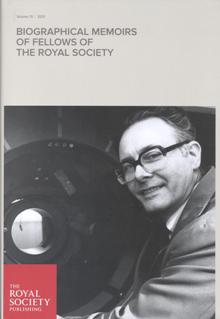
J. C. Ward
John Clive Ward
J. C. Ward, Memoirs of a Theoretical Physicist (Optics Journal, Rochester, New York, 2004). [PDF]
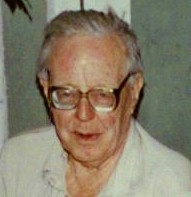
John Clive Ward was one of the most brilliant British physicists of the post war era. A contributor to the Standard Model and the creator of the famed Ward Identities his contributions are
discussed in numerous books on quantum physics and theoretical physics.
The Ward Identities have their origin in a 1950 paper published in Physical Review. This was a succinct master piece authored by J. C. Ward and entitled An identity in quantum electrodynamics. Building on previous work by Dyson this elegant letter proved in seven steps one of the most important and celebrated results of renormalization theory. In a following paper, published in 1951, Ward extended the initial result to a set of identities. Today, the Ward Identity or Ward Identities, are standard teachings in theoretical physics and continue to be the focus of considerable research activity. More than twenty thousand journal physics papers have been published with Ward Identity or Ward Identities either in their titles or texts.
In addition to his profound influence in field theory, and quantum electrodynamics, he
made significant and fundamental contributions to quantum mechanics,
elementary particle physics, quantum solid-state physics,
and quantum statistics. However, his contributions have not yet received the widespread recognition they deserve. It has been
said that for decades physicists have made use of his principles and
developments "often without knowing it, and generally without quoting
him." In this regard, it was Ward whom, in 1947, derived the equation for the quantum entanglement of orthogonal polarizations for two particles propagating in different directions ( | x, y > - | y, x > ).
Born in London, the 1st of August of 1924, John Ward was educated at Oxford. His doctoral advisor was M. H. L. Pryce who, like P. A. M. Dirac, was a student of R. H. Fowler. Following a series of appointments John Ward arrived to Australia in 1967, via Princeton and Johns Hopkins, and played a major role in creating a high-class physics program at the School of Mathematics and Physics of Macquarie
University.
Ward's physics curriculum at Macquarie was based on the now famous Feynman Lectures on Physics and included a superb experimental physics program. Under his influence, and with the assistance of several colleagues (including R. A. Aitchison, C. E. Curnow, E. Laisk, and R. E. B. Makinson), the foundations of a Macquarie
physics education became a combination of courses in electromagnetism,
quantum physics, solid state physics, advanced electronics, and experimental physics in addition to courses in applied
mathematics.
At Macquarie he became known for his forceful defense of science, high academic standards, and for his uncompromising honesty. In this regard, he openly and vigorously supported the student science reform movement that permanently changed the degree structure of the university. This transformative innovation strengthened significantly the structure of the sciences at Macquarie and Ward considered it a "most important accomplishment."
Although himself a gifted theoretician Ward always held a deep rooted respect for experimental physics and
engineering. This well balanced and utilitarian philosophy was well reflected in the nature of the Macquarie physics degree.
Ward was a Fellow of The Royal Society and received several coveted physics awards including the Heinaman Prize, the Hughes Medal, and the Guthrie Medal. His contributions to theoretical physics inspired admiration among his
most illustrious peers. In this regard, Sakharov classified him as one of the titans of quantum electrodynamics alongside Dyson, Feynman, Schwinger, and Tomonaga. In 1988 one of his former students met Julian Schwinger at a conference reception in Lake Tahoe. Once Schwinger knew that the young physicist was from Macquarie, he smiled and immediately proceeded to focus the conversation on one topic alone: John Ward.
In a contemporaneous magazine article (published in The Bulletin) he was described as a "restrained rather distant Englishman." Distance apart, he was the epitome of a physicist and a scholar, a man who exerted a distinct influence in the education of those physicists who knew him. An accomplished pianist, and french horn player, he spent the last years of his life in Vancouver Island, Canada. During this period, his time was devoted to his physics, wine making, and
traveling to places like Europe, Mexico, and the south of South America.
I shared the last couple of days of 1999 and the first day of 2000, with Ward, in Santiago de Chile, at the foot of the majestic Andes. We discussed a litany of topics from physics to geopolitics. We laughed hard, tasted wine, and celebrated our iconic achievement at Macquarie. He was looking forward to get back to work on his physics and he suggested teaching jointly a refreshing physics course, for high school teachers in Santiago, similar to a course he had taught back at Macquarie. However, it would not be. John passed away following a trip to the South
Pacific on the 6th of May of 2000.
F. J. Duarte
Bibliography
- M. H. L. Pryce and J. C. Ward, Angular correlation effects with
annhilation radiation, Nature 160, 435 (1947).
- F. J. Duarte and M. Brandt, Science notes, Arena 12(6), 7 (1979).
- F. J. Duarte and M. Brandt, Science notes, Arena 12(7), 5 (1979).
- G. Sheridan, Australian physicist wins Guthrie Medal, The Bulletin 101(5239), 49-50 (1980).
- G. Hooft, Gauge theories of the forces between elementary particles, Sci. Amer. 242,
104-138 (1980).
- A. Sakharov, Memoirs (Knopf, New York, 1990).
- P. W. Anderson, Is complexity physics?, Physics Today 44 (7), 9-11
(1991).
- N. Dombey and E. Grove, Britain's thermonuclear bluff, The London Review of Books, 22nd of October, 1992.
- M. Dunhill, Oxford note on the Hilary Term (1995).
- R. Delbourgo, The Nobel prize in physics 1999, The Physicist 36, 215-219 (1999).
- R. H. Dalitz and F. J. Duarte, John Clive Ward, Physics Today 53 (10), 99-100 (2000).
- F. J. Duarte, The origin of quantum entanglement experiments based on polarization measurements, The European Physical Journal H. 37, 311–318 (2012).
Publications by John Clive Ward
- A. M. Binnie and J. C. Ward, Stresses due to internal hydrostatic pressure in thin-walled vessels of stream-line form, Aeronautical J. 48, 538-543 (1944).
- M. H. L. Pryce and J. C. Ward, Angular correlation effects with
annhilation radiation, Nature 160, 435 (1947).
- J. C. Ward, Some Properties of Elementary Particles (Oxford University, Oxford, 1949).
- J. C. Ward, The scattering of light by light, Phys. Rev. 77, 293 (1950).
- J. C. Ward, An identity in quantum electrodynamics, Phys. Rev. 78, 182 (1950).
- J. C. Ward, A convergent non-linear field theory, Phys. Rev. 79, 406 (1950).
- J. C. Ward, Quantum effects in the interaction of electrons with high frequency fields, Phys. Rev. 80, 119 - 119 (1950).
- J. C. Ward, On the renormalization of quantum electrodynamics, Proc. Phys. Soc. A 54, 54-56.
- J. C. Ward, Renormalization theory of the interaction of nucleons,
mesons, and photons, Phys. Rev. 84, 897-901 (1951).
- J. C. Ward and J. Wilks, The velocity of second sound in liquid
helium near the absolute zero, Phil. Mag. 42, 314-316 (1951).
- J. C. Ward and J. Wilks, Second sound and the thermo-mechanical
effect, Phil. Mag. 43, 48-50 (1952).
- M. Kac and J. C. Ward, A combinatorial solution of the two-
dimensional Ising model, Phys. Rev. 88, 1332-1337 (1952).
- R. B. Potts and J. C. Ward, The combinatrial method and the two-dimensional ising model, Prog. Theor. Phys. 13, 38-46 (1955).
- E. W. Montroll and J. C. Ward, Quantum statistics of interacting particles; general theory and some remarks on properties of an electron gas, Phys. Fluids 1, 55-72 (1958).
- E. W. Montroll and J. C. Ward, Quantum statistics of interacting particles II. Cluster integral development of transport coefficients, Physica 25, 423-443 (1959).
- A. Salam and J. C. Ward, Weak and electromagnetic interactions, Nuovo Cimento 11,
568-577 (1959).
- J. M. Luttinger and J. C. Ward, Ground-state energy and many-
fermion system, Phys. Rev. 118, 1417-1427 (1960).
- A. Salam and J. C. Ward, Δl = ½ rule, Phys. Rev. Lett. 5, 390 (1960).
- A. Salam and J. C. Ward, On a gauge theory of elementary interactions, Nuovo Cimento 19, 166-170 (1961).
- A. Salam and J. C. Ward, Vector field associated with the unitary theory of the Sakata model, Nuovo Cimento 20, 419-421 (1961).
- A. Salam and J. C. Ward, On the symplectic symmetry, Nuovo Cimento 20, 1228-1230 (1961).
- E. W. Montroll, R. B. Potts, and J. C. Ward, Correlations and
spontaneous magnetization of the two-dimensionaol Ising model,
J. Math. Phys. 4, 308-322 (1963).
- A. Salam and J. C. Ward, Electromagnetic and weak interactions,
Phys. Lett. 13, 168-171 (1964).
- A. Salam and J. C. Ward, Gauge theory of elementary interactions,
Phys. Rev. 136 B, 763-768 (1964).
- J. C. Ward, General relativity, the Dirac equation, and higher symmetries, Proc. Natl. Acad. Sci. USA 75, 2568
(1978).
- J. C. Ward, Nunca me arrepentido que fiz, Publico Lisbon, 4 April, 1992.
- J. C. Ward, Memoirs of a Theoretical Physicist (Optics Journal, Rochester NY, 2004).
Articles on the physics and life of John Clive Ward
- R. Delbourgo, John Clive Ward 1924-2000, CERN Courier 40 (6) (2000).
- F. J. Duarte and J. A. Piper, John Clive Ward, FRS, The Physicist 37 (4), 145-146 (2000).
- F. J. Duarte, J. C. Ward: elegant physics and a practical perspective, Optics and Photonics News 11 (8), 62-63 (2000).*
- R. H. Dalitz and F. J. Duarte, John Clive Ward, Physics Today 53 (10), 99-100 (2000).
- F. J. Duarte, The man behind an identity in quantum electrodynamics, Australian Physics 46 (6), 171-175 (2009).
Note 1: a biographical note on Australian Physicist Richard ("Dick") H. Dalitz, a long time friend of John C. Ward, is available from Physics at Oxford. A more extensive article including a listing of Dalitz's works is entitled The scientific heritage of Richard Henry Dalitz, FRS (1925-2006) (by I. J. R. Aitchison et al.).
Note 2: in a long series of conversations with Dick Dalitz, whilst preparing the article on John Ward for Physics Today, it became clear to me that Dick was convinced tha John's contribution to the Standard Model was more extensive than accepted by conventional wisdom. Dick also accepted John's relevance to Britain's H-Bomb efforts. This was made explicit in his contribution to the Physics Today article. Further, Dick was working on a book on John's papers and contributions to physics which was the focus of my last conversation with him (Frank Duarte).
Note 3: an article describing a little known idea of John Ward, in the isotope separation field, known in Australia as the Ward Process is described in:
Book citations (partial list)
Technical
- E. R. Caianiello, Field Theory and the Many Body Problem (Academic, New York, 1961).
- B. Kursunoglu, Modern Quantum Theory (Freeman, New york, 1962).
- D. H. Lith, An Introduction to Current Algebra (Clarendon, Oxford, 1970).
- E. Farhi and J. W. Farhi, Dynamical Gauge Symmetry Breaking (World
Scientific, London, 1982).
- R. Bonnett, Gauge Field Theories (Taylor and Francis, London, 1987).
- C. Kittel, Quantum Theory of Solids (Wiley, New York, 1987).
- R. N. Mohapatra, Massive Neutrinos in Physics and Astrophysics (World
Scientific, London, 1991).
- B. Hatfield, Quantum Field Theory of Point Particles and Strings (Perseus, Cambridge,
MA, 1992).
- R. D. Mattuck, A Guide to Feynman Diagrams in the Many-Body Problem (Dover,
New York, 1992).
- M. Kaku, Quantum Field Theory (Oxford University, Oxford, 1993).
- M. Wadati, Selected Papers of Morikazu Toda (World Scientific, London,
1993).
- M. E. Peskin and D. V. Schroeder, An Introduction to Quantum Field
Theory (Perseus, Reading, 1995).
- E. R. Pike and S. Sarkar, The Quantum Theory of Radiation (Clarendon, Oxford, 1995).
- E. K. Salje et al. (Eds.), Polarons and Bipolarons in High Tc
Superconductors and Related Materials (Cambridge University, London, 1995).
- S. Weinberg, The Quantum Theory of Fields II (Cambridge, Melbourne, 1996).
- C. Quigg, Gauge Theories of the Strong, Weak, and Electromagnetic
Interactions (Wiley, New York, 1997).
- A. Bottcher et al., Introduction to Large Truncated Toeplitz Matrices
(Springer, Berlin, 1998).
- A. J. Buras (Eds.), Heavy Flavours II (World Scientific, London, 1998).
- M. H. Krieger, Constitutions of Matter: Mathematically Modeling the Most
Everyday of Physical Phenomena (University of Chicago, Chicago, 1998).
- V. G. Baryakhtar et al., Theory of Adiabatic Potential and Atomic
Properties of Simple Metals (Taylor and Francis, London, 1999).
- R. Haussmann, Self-Consistent Quantum Field Theory and Bosonization of
Strongly Correlated Electron Systems (Springer, Berlin, 1999).
- P. H. Frampton, Gauge Field Theories (Wiley-IEEE, New York, 2000).
- R. Gambini and J. Pullin, Loops, Knots, Gauge Theories and Quantum Gravity
(Cambridge University, Cambridge, 2000).
- L. M. Krauss, Quintessence: The Search for Missing Mass in the Universe
(Basic Books, New York, 2001).
- J. Zinn-Justin, Quantum Field Theory and Critical Phenomena (Oxford
University, London, 2002).
- M. H. Krieger, Doing Mathematics: Convention, Subject, Calculation, Analogy
(World Scientific, London, 2003).
- H. Umezawa, Advanced Field Theory: Micro, Macro, and Thermal Physics
(Springer, Berlin, 2003).
- A. Zee, Quantum Field Theory in a Nutshell (Princeton University, Princeton, 2003).
- J. Linderberg and Y. Ohrn, Propagators in Quantum Chemistry (Wiley-IEEE,
New York, 2004).
- J. D. Walecka, Theoretical Nuclear and Subnuclear Physics (World
Scientific, London, 2004).
- J. Rammer, Quantum Field Theory of Non-Equilibrium States (Cambridge University, Cambridge, 2007).
- K. H. Bennemann and J. B. Ketterson, Superconductivity (Springer, Berlin, 2008).
- P. H. Framton, Gauge Field Theories, 3rd Ed. (Wiley VCH, Weinheim, 2008).
- P. Misra, Heavy Fermion Systems (Elsevier, 2008).
- C. M. Van Vliet, Equilibrium and Non Equilibrium Statistical Mechanics (World Scientific, London, 2008).
- V. Begun et al., Progress in High Energy Physics and Nuclear Safety (Springer, Berlin, 2009).
- W. Greiner and J. Reinhardt, Quantum Electrodynamics, 4th Ed. (Springer, Berlin, 2009).
- A. V. Ling (Ed.), Trends in Boson Research (Nova, 2009).
- F. J. Duarte, Quantum Optics for Engineers (CRC, New York, 2014).
- F. J. Duarte, Fundamentals of Quantum Entanglement, 1st Ed. (Institute of Physics, Bristol, 2019).
- F. Trotter, A Philosophical Observation on Quantum Mechanics (Universite Lausanne, Lausanne, 2021).
- F. J. Duarte and T. S. Taylor, Quantum Entanglement Engineering and Applications (Institute of Physics, Bristol, 2021).
- O. Freire (Ed.), The History of Quantum Interpretations (Oxford University, Oxford, 2022).
- F. J. Duarte, Fundamentals of Quantum Entanglement, 2nd Ed. (Institute of Physics, Bristol, 2022).
General
- B. N. Kursunoglu and E. P. Wigner (Eds.), Paul Adrien Maurice Dirac (Cambridge University, Cambridge, 1987).
- F. D. Peat, Superstrings (Contemporary Books, New York, 1988).
- A. Sakharov, Memoirs (Knopf, New York, 1990).
- B. Mansfield and M. Hutchinson, Liberality of Opportunity (Macquarie University, Sydney, 1992).
- L. P. Kadanoff, From Order to Chaos: Essays: Critical, Chaotic, and
Otherwise (World Scientific, London, 1993).
- S. S. Schwebe, QED and the Men Who Made It (Princeton University,
Princeton, 1994).
- S. Weinberg, Dreams of a Final Theory (Vintage, New York, 1994).
- L. M. Brown et al. (Ed.), The Rise of the Standard Model: A History of
Particle Physics from 1964 to 1979 (Cambridge University, Cambridge, 1997).
- G. 't Hooft, In Search of the Ultimate Building Blocks (Cambridge University, Cambridge, 1997).
- J. Gribbin, The Search for Superstrings, Symmetry, and the Theory of Everything (Little, Brown & Co, Boston, 1999).
- H. Kragh, Quantum Generations (Princeton University, Princeton, 1999).
- A. Pickering, Constructing Quarks: A Sociological History of particle
Physics (University of Chicago, Chicago, 1999).
- L. Arnold, Britain and the H-Bomb (Palgrave, New York, 2001).
- D. Kaiser, Drawing Theories Apart: The Dispersion of Feynman Diagrams in Postwar Physics (University of Chicago, Chicago, 2005).
- A. Moyal, Maverick Mathematician: The Life and Science of J. E. Moyal (Australian National University, Camberra, 2006).

- A. Zee, Fearful Symmetry (Princeton University, Princeton, 2007).
- G. Fraser, Cosmic Anger (Oxford University, London, 2008).

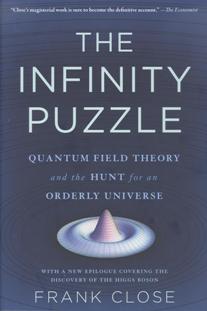
- F. Close, The Infinity Puzzle: Quantum Field Theory and the Hunt for an Orderly Universe (Oxford University, Oxford, 2011).
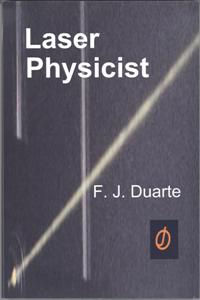
- F. J. Duarte, Laser Physicist (Optics Journal, New York, 2012).
Additional Biographies
Ronald E. Aitchison
Frederick Chong
Angel Costela
Richard H. Dalitz
Francisco J. Duarte
Catherine P. Foley
Lloyd W. Hillman
Robert O. James
Elmar Laisk
Willis E. Lamb
Ignacio E. Olivares
Brian J. Orr
James A. Piper
Arthur W. Pryor
Roberto Sastre
Thomas M. Shay
Kathleen M. Vaeth
Colin E. Webb
Macquarie Physics History
Text of the original article on John Clive Ward
*This paper was published in Optics and Photonics News and is made available as an electronic reprint with the permission of OSA. One print or electronic
copy may be made for personal use only. Systematic or multiple reproduction, distribution to multiple locations via electronic or other means,
duplication of any material in this paper for a fee or for commercial purposes, or modification of the content of the paper are prohibited.
Copyright OSA (www.osa.org/pubs/osajournals.org).
Page first published on the 13th of May, 2000. Updated on the 24th of April, 2024.